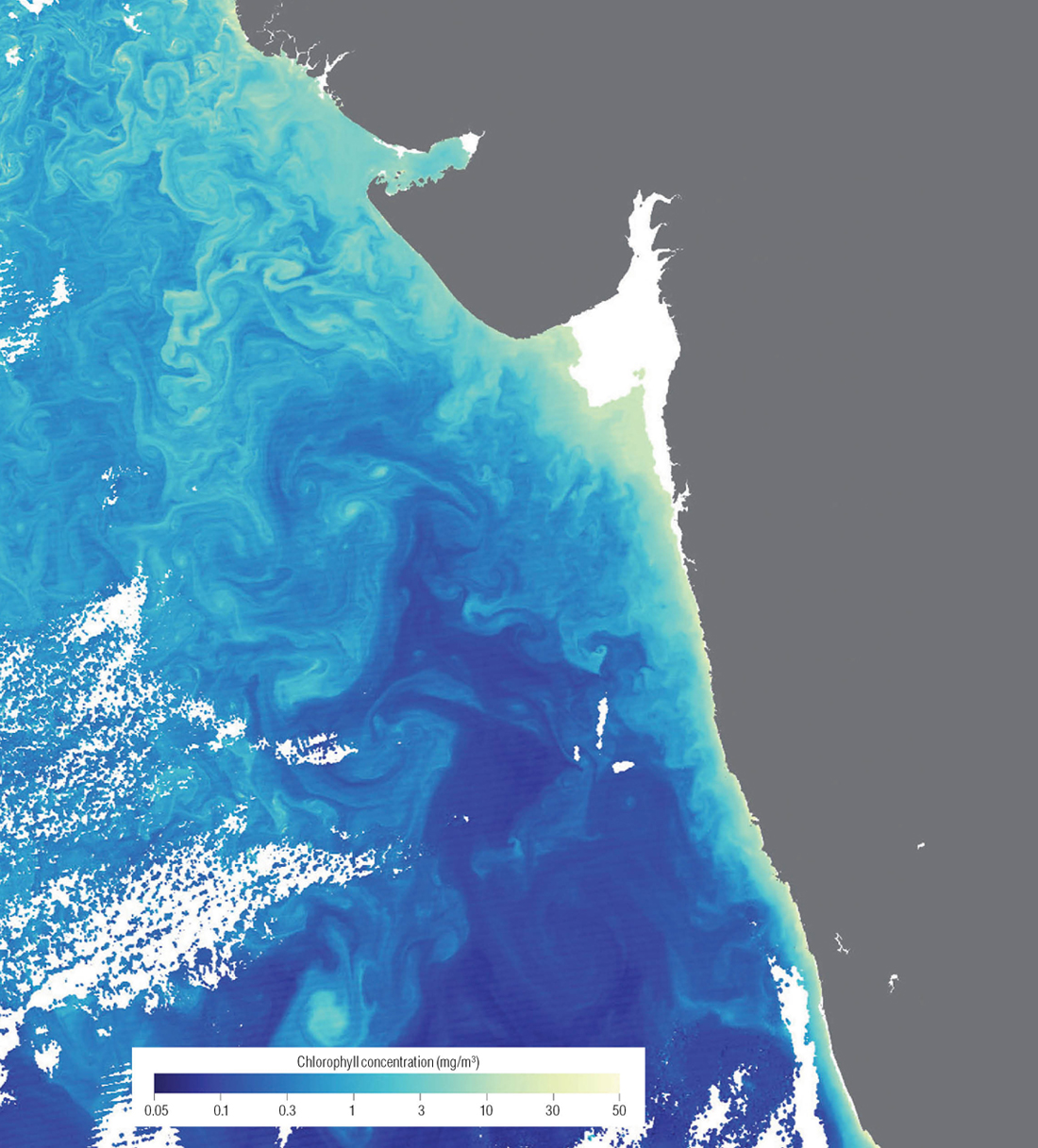
Photo courtesy: NASA Chlorophyll-a, the dominant photosynthetic pigment of phytoplankton—an index of phytoplankton biomass, is used as the primary parameter for the remote detection of algal blooms.
Abstract: The present century is experiencing frequent widespread occurrences of algal bloom events in different regions of the world’s oceans. The bloom events more often deteriorate the functions of the ecosystem. Therefore, fishermen, fishery resource managers, researchers, ecologists, pollution monitoring agencies and environmentalists demand continuous monitoring of bloom episodes. This article presents the satellite based algal bloom detection and monitoring service of ESSO-INCOIS for the Indian waters.
The authors are Project Scientist B, Scientist C and Scientist E respectively with Earth System Sciences Organisation-Indian National Centre for Ocean Information Services (ESSO-INCOIS) and are part of the Ocean Information and Forecast Service Group (ISG). aneesh@incois.gov.in. The article should be cited as Baliarsingh S.K., A. Samanta and A. Lotliker, 2020. Monitoring of Algal Blooms in the Indian Seas, Geography and You, 20(6-7): 62-67
What if India's pathway to net zero does not end at factories—but begins where terrestrial meets the coastal? As carbon emissions rise and climate risks intensify, the search for solutions has largely...
India is set to embark on a new chapter in its Polar exploration journey with the construction of Maitri II. The Indian government plans to establish a new research station near the existing Maitri ba...
The Deep Ocean Mission (DOM), approved by the Government of India in 2021 under the Ministry of Earth Sciences (MoES), represents a strategic step in realizing Sustainable Development Goal 14 (SDG 14:...
China recently announced restrictions on the export of seven rare earth elements (REEs), soon after US President Donald Trump decided to impose tariffs. As the world's dominant supplier—responsible fo...